Observed
The public file defines a device-fit workflow, a shielding-liner target, closure path, carry orientation, and MOLLE-compatible enclosure role.
Request route This is not a buy-now product. A signal-control pouch requires a workshop review around the exact device, closure, mounting, materials, and validation plan.
This page documents phone-isolation research from Koocanusa Tech & Tactics for KTT Goods Co., its goods division. Signal-control construction is now treated as an option inside the broader made-to-order pouch workshop and still requires validation on the finished build.

Concept images These images show a research direction, not a finished retail product. Any future signal-control build requires validation on the completed enclosure.


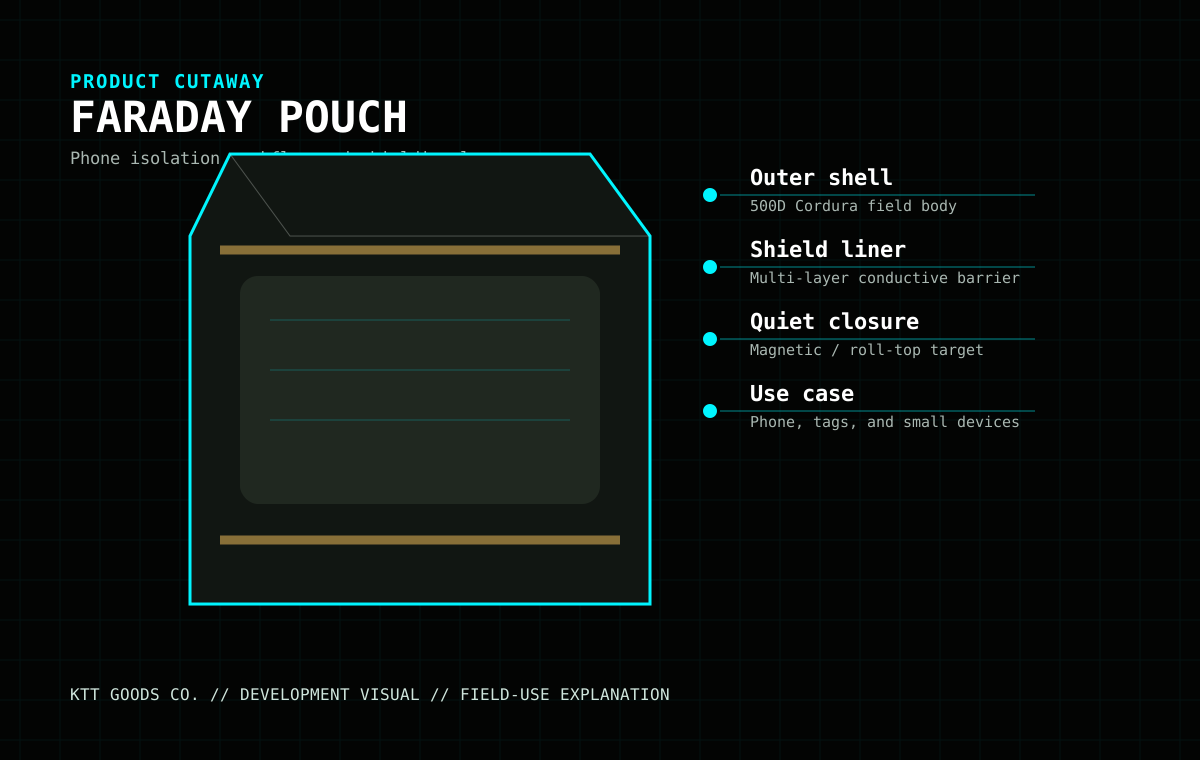
Concept imagery and the illustration below describe a design goal. They do not establish protection, range, or attenuation.
The Faraday Pouch is a specialty signal-management study. RF means radio frequency, and MOLLE means the webbing system used to mount pouches on packs or carriers. Use this file to understand the construction problem, then bring the actual device and mounting requirement into the Custom Pouch Workshop.
The public file defines a device-fit workflow, a shielding-liner target, closure path, carry orientation, and MOLLE-compatible enclosure role.
No finished retail sample or measured attenuation result is published. The meters below are simulations, not measurements.
A completed enclosure must be checked with the exact device, radios, closure state, and repeatable measurement method before any attenuation claim.
Phones can expose cellular, Wi-Fi, Bluetooth, NFC, and location-related surfaces depending on settings, apps, carrier behavior, and environment. This archived study asks whether a purpose-built enclosure could support deliberate offline storage. No no-signal result is established here.
The KTT Faraday Pouch was explored as a MOLLE-compatible enclosure with an attenuation target. In plain English: it is meant to mount like field gear and physically reduce wireless signals when closed. The design target is a multi-layer shielding liner, quiet access, 500D Cordura exterior, roll-top retention, and a field-friendly structure that can be staged on a kit instead of buried in a bag.
The threat model is simple: radios create opportunities for correlation. Cell, Wi-Fi, Bluetooth, NFC, and app-level location data can all contribute to a pattern-of-life picture. Software settings help, but they are device-specific and easy to forget. A shielding enclosure is one design approach; its effect depends on the finished construction, closure, device, frequencies, and test conditions.
This file remains public because the construction problem is useful. For a real project, bring the device dimensions, access routine, mounting position, and required validation to the Custom Pouch Workshop.
The proposed shell, liner, and closure work together. The illustration explains their roles; a completed enclosure must still be tested with the actual device.
Select the use case and the pouch brief updates with the practical loadout notes.
This is the archived design direction. No standalone release date or finished-build result is published.

